Evaluating Spring Duck Digital Paper for Seasonal Design Projects
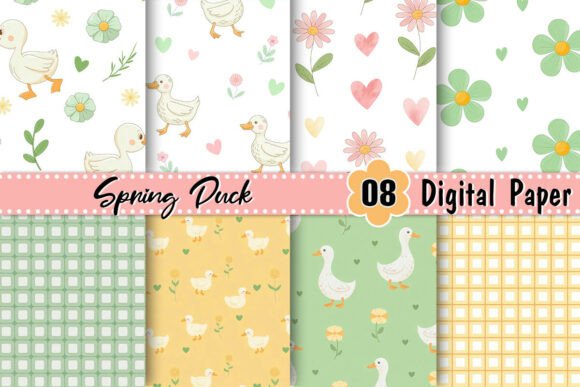
When curating assets for spring-themed creative projects, the selection of background textures and patterns plays a pivotal role in establishing the right mood. Among the myriad of options available on digital marketplaces, Spring Duck Digital Paper has emerged as a specific resource worth evaluating. This collection typically consists of eight high-resolution JPG images featuring non-seamless patterns centered around a duck motif. For designers, crafters, and content creators aged 20 to 50 who are weighing their options for upcoming seasonal work, understanding the technical specifications and practical applications of this specific asset is essential before making a purchase or download decision.
The core offering of this product is straightforward: a set of eight distinct digital papers rendered at 300 DPI (dots per inch). This resolution standard is critical for anyone intending to use these images for physical outputs. Unlike screen-only graphics which often hover around 72 DPI, a 300 DPI rating ensures that if you were to print these designs on cardstock for invitations, scrapbook pages, or greeting cards, the image quality would remain crisp without pixelation. However, the "non-seamless" nature of these files introduces specific considerations regarding how they can be implemented in both digital and print workflows.
Understanding the Non-Seamless Format and Its Implications
A primary factor in deciding whether Spring Duck Digital Paper fits your project needs lies in understanding the difference between seamless and non-seamless patterns. Seamless patterns are designed to tile infinitely; when placed side-by-side or stacked, the edges align perfectly to create a continuous background with no visible breaks. This is ideal for website backgrounds, large-format wallpaper, or filling expansive canvas areas in graphic design software.
In contrast, the non-seamless format of this duck-themed collection means each of the eight JPG files is a standalone composition. The imagery likely features a central focal point or a specific arrangement of ducks and spring elements that does not necessarily connect logically to an adjacent copy of the same image. While this might seem like a limitation at first glance, it often provides greater artistic control for specific use cases. For instance, if you are designing a layered scrapbook page, you do not want a repeating pattern that distracts from photos or journaling cards. Instead, you need a distinct vignette or a textured backdrop that acts as a singular piece of art. In this context, the non-seamless nature of Spring Duck Digital Paper becomes a strength rather than a drawback, offering ready-made compositions that require less manipulation to look intentional.
Comparative Analysis: Static Papers vs. Generative Tools
When evaluating resources, it is helpful to compare pre-made digital papers against modern generative AI tools or vector-based pattern builders. Generative tools allow for infinite customization, where a user can prompt for "cute ducks in spring flowers" and receive endless variations. However, these tools often struggle with consistency in style across multiple images and may lack the specific 300 DPI print readiness without upscaling, which can introduce artifacts.
Spring Duck Digital Paper offers a curated, consistent aesthetic. All eight images in the pack share a cohesive color palette and illustrative style, ensuring that if you use three different sheets in a single project, they harmonize visually. This consistency is difficult to achieve quickly with generative tools unless one possesses advanced prompting skills and post-processing knowledge. Furthermore, because these are raster images (JPGs), they behave predictably in all editing software, from basic mobile apps to professional suites like Adobe Photoshop or Procreate. There is no need to manage complex vector nodes or worry about software compatibility issues that sometimes arise with newer file formats.
Practical Applications and Best-Fit Scenarios
Determining the right fit for Spring Duck Digital Paper depends largely on the end goal of your project. For professionals and hobbyists creating physical goods, the 300 DPI resolution makes this collection highly suitable for:
- Greeting Cards and Invitations: The high resolution ensures clean lines when printed on heavy stock. The non-seamless design allows the duck imagery to serve as a featured element on the front of a card without needing to mask out repetitive edges.
- Scrapbooking and Journaling: Digital scrapbookers can import these JPGs directly into their layouts. Since the patterns are not meant to tile, they function beautifully as full-page backgrounds or as elements to be cropped and layered under photos.
- Sticker and Planner Decor: Crafters using cutting machines (like Cricut or Silhouette) can print these sheets and cut out specific duck motifs or background shapes to embellish physical planners.
Conversely, there are scenarios where this product might not be the optimal choice. If your primary goal is to create a scrolling background for a mobile app or a website header that needs to stretch across various screen sizes without repetition, a seamless vector pattern or a CSS-generated gradient might be more efficient. Additionally, because the files are provided as JPGs, they utilize lossy compression. While generally imperceptible at 300 DPI for standard prints, users requiring transparent backgrounds will need to perform additional steps to remove the white or colored background inherent in the JPG format, whereas a PNG or SVG alternative might offer transparency out of the box.
Weighing the Trade-offs: Convenience vs. Flexibility
The decision to utilize Spring Duck Digital Paper ultimately comes down to a trade-off between convenience and flexibility. The convenience factor is high; you receive eight finished, high-quality images immediately. There is no learning curve associated with generating patterns or adjusting vector points. The artistic direction is already established, which saves time for users who need to meet tight deadlines for Easter promotions, spring sales, or personal family projects.
However, the flexibility is somewhat bounded by the fixed resolution and the non-seamless structure. You cannot infinitely scale these images beyond their original dimensions without losing quality, nor can you easily reconfigure the elements within the image without advanced photo editing skills. For a user who needs a specific layout—such as a duck positioned strictly in the bottom right corner with open space above—a customizable vector kit might be preferable. Yet, for the majority of users looking for "plug-and-play" aesthetics that evoke a cheerful spring atmosphere, the predefined composition of these digital papers often provides exactly what is needed with minimal effort.
Making an Informed Decision
Before finalizing your choice, consider the scope of your project. If you are producing a small batch of printed materials or digital social media graphics where unique, non-repeating visuals are preferred, this collection offers excellent value. The thematic focus on ducks provides a niche appeal that stands out from generic floral spring backgrounds, adding a touch of whimsy and character to your work.
It is also worth noting the file format. JPG is universally compatible, meaning you can use these images on virtually any device or software platform without needing specialized plugins. This universality reduces friction in the workflow, allowing you to focus on the creative assembly rather than technical troubleshooting. However, always verify the specific dimensions (pixel width and height) provided in the product details alongside the DPI rating to ensure they meet the size requirements of your intended print run.
In summary, Spring Duck Digital Paper represents a specialized tool in the broader toolkit of digital design resources. It excels in situations requiring high-quality, static, themed backgrounds for print and layered digital compositions. While it may not replace the need for seamless tiles in web development or vectors for scalable branding, it fills a vital niche for crafters and designers seeking immediate, cohesive, and charming springtime visuals. By understanding the distinction between its non-seamless nature and other pattern types, you can better determine if this resource aligns with your specific creative objectives.